Data-Driven Parachute Design
Can a data-driven search beat a hole in the middle?
Compare data-driven design methods on one honest question: given 250 cm² of plastic, which canopy shape lands slowest, and does a search over shapes find anything a central vent does not.
6.31 m/s
Lowest checked landing speed, 12% central vent
CFD estimate under the simulation's assumed payload and drop height, against 6.45 m/s for the plain canopy and 8.9 m/s free fall. Not yet a physical measurement.
0.97
Held-out IoU, 9-D autoencoder
Reconstruction overlap on sampled shapes the autoencoder never trained on, out of 1,883 sampled shapes.
−0.052 m/s
GA median best score against random search
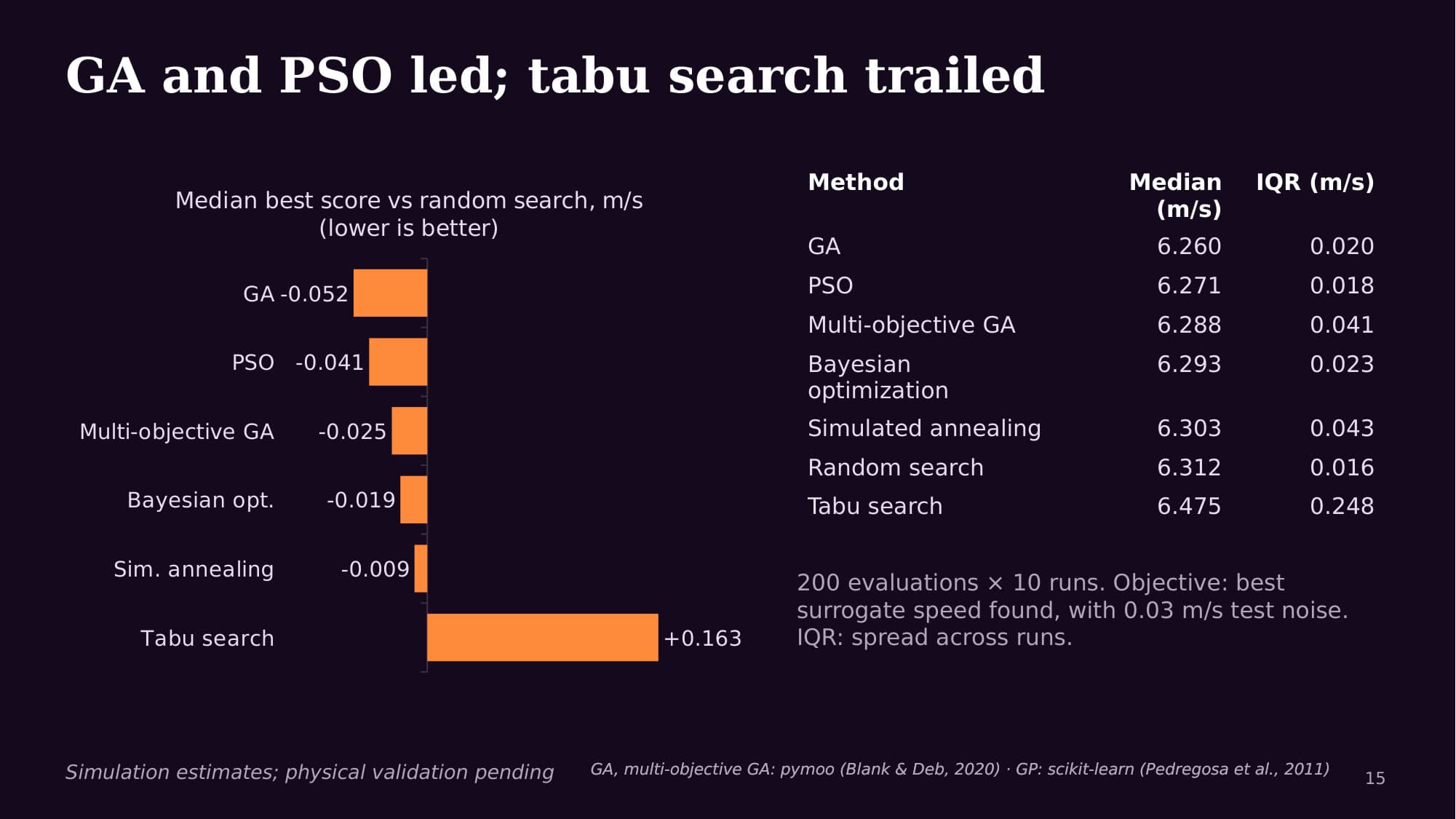
200 evaluations × 10 runs per method on the surrogate, with 0.03 m/s test noise. GA median 6.260 m/s against 6.312 m/s for random search.
780
CFD runs in the inflation scan
Converged designs at both angles; 64% stable. Plus 130 CFD runs on canopies and 45 form-found converged designs.
Problem
The setup is deliberately small: 250 cm² of plastic cut into any flat 2D shape, six lines, a payload dropped from 4 m. Free fall lands at 8.9 m/s. The objective is the lowest landing speed, with pitch stability as a second objective.
The course question is comparative: which data-driven design methods, encodings, dimensionality reduction, surrogate models and optimisers, actually help on a problem like this, judged by one scoring rule applied identically to every method. The obvious baseline is a plain canopy with a hole in the middle, and the interesting outcome is whether a search can beat it.
What I built
The whole pipeline to date, from shape encoding to the benchmark, with every output tagged by evidence level so a simulation estimate cannot be mistaken for a measured result.
- Shape encodings at 3, 7 and 9 variables, from outline and slit parameters to the heights of 61 smooth bumps in 9 symmetric groups; every design must be cuttable, and 78% of free-form samples pass
- Form-finding by dynamic relaxation, turning a flat cut pattern into an inflated canopy shape
- PCA, autoencoder and VAE dimensionality reduction over 1,883 sampled shapes
- OpenFOAM v2406 CFD (k-ω SST) on form-found canopies, checked against reference drag coefficients for a disc and a cup
- MuJoCo drop simulator with a virtual BNO085 IMU and virtual RealSense RGB-D, writing the same observation bundle a real drop will produce
- A shared sim/real estimation pipeline: ArUco PnP, depth detection, LED clock sync, an error-state EKF with an RTS smoother
- Gaussian-process surrogate and a benchmark of GA, PSO, multi-objective GA, Bayesian optimisation, simulated annealing, tabu search and random search
- ESP32-S3 IMU logger firmware and a printed drop-day kit with cutting templates for the real tests
From encoding to a checked design
The surrogate is cheap enough to search and wrong enough to need checking. Winners go back through fresh CFD rather than being reported off the model.
Encode a shape
3, 7 or 9 design variables; uncuttable shapes are rejected.
Form-find and run CFD
Dynamic relaxation for the inflated shape, then OpenFOAM.
Fit the surrogate
Gaussian process trained on the design-of-experiments runs.
Search on the surrogate
GA, PSO, Bayesian optimisation and others, 200 evaluations each.
Fresh CFD on the winners
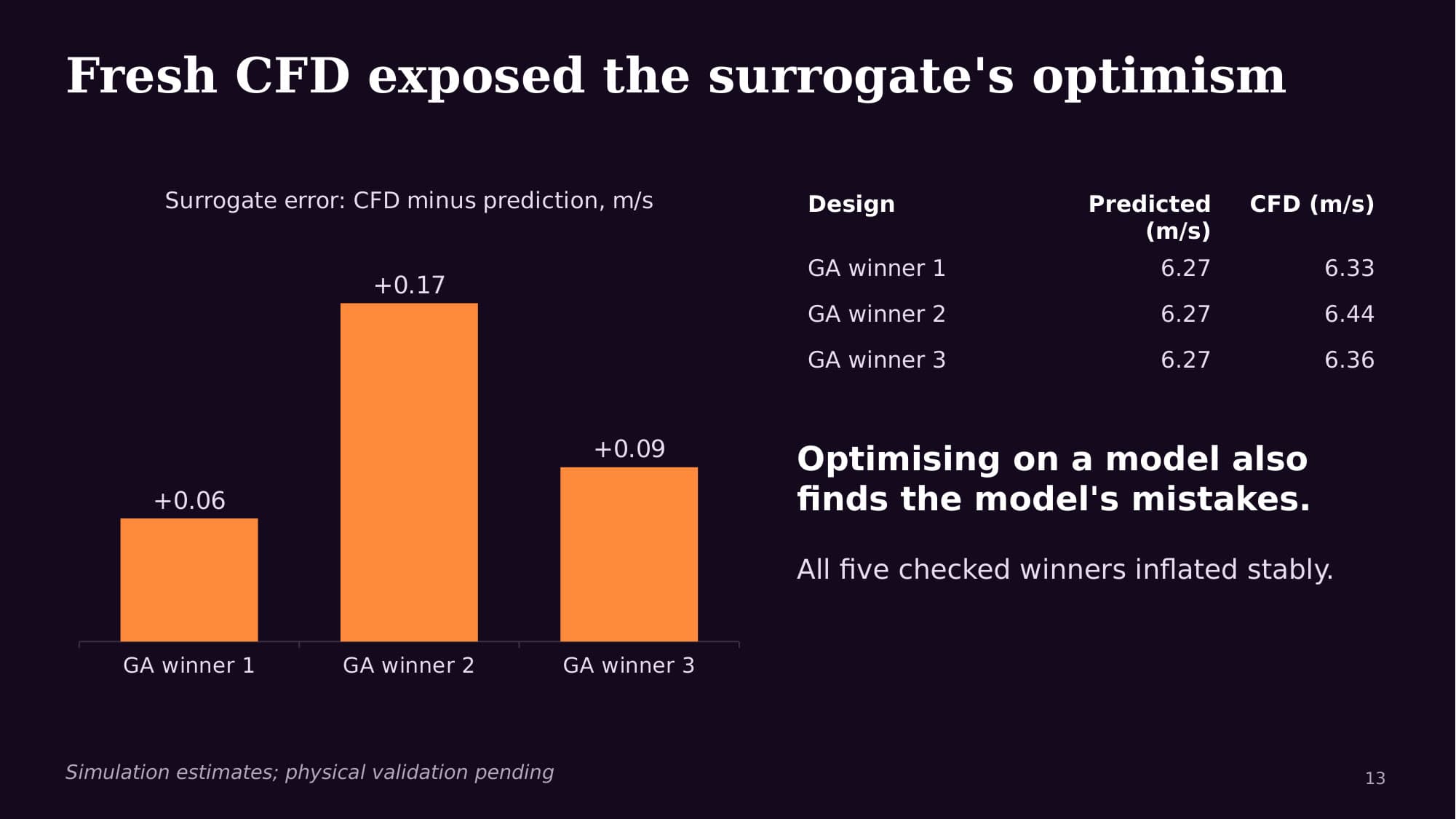
Surrogate optimistic by 0.06 to 0.17 m/sAll five checked winners inflated stablyReal drops decide
Pending. Simulation estimates are not the result.
Optimiser benchmark
Median best surrogate landing speed found, 200 evaluations × 10 runs. Lower is better. Simulation estimates.
| Method | Median (m/s) | IQR (m/s) |
|---|---|---|
| GA | 6.260 | 0.020 |
| PSO | 6.271 | 0.018 |
| Multi-objective GA | 6.288 | 0.041 |
| Bayesian optimisation | 6.293 | 0.023 |
| Simulated annealing | 6.303 | 0.043 |
| Random search | 6.312 | 0.016 |
| Tabu search | 6.475 | 0.248 |
Surrogate against fresh CFD
The three GA winners, as predicted and as re-checked.
| Design | Predicted (m/s) | CFD (m/s) |
|---|---|---|
| GA winner 1 | 6.27 | 6.33 |
| GA winner 2 | 6.27 | 6.44 |
| GA winner 3 | 6.27 | 6.36 |
Experiments
Vent against plain canopy
- Question
- Does a central hole land slower than a plain canopy of the same area?
- Method
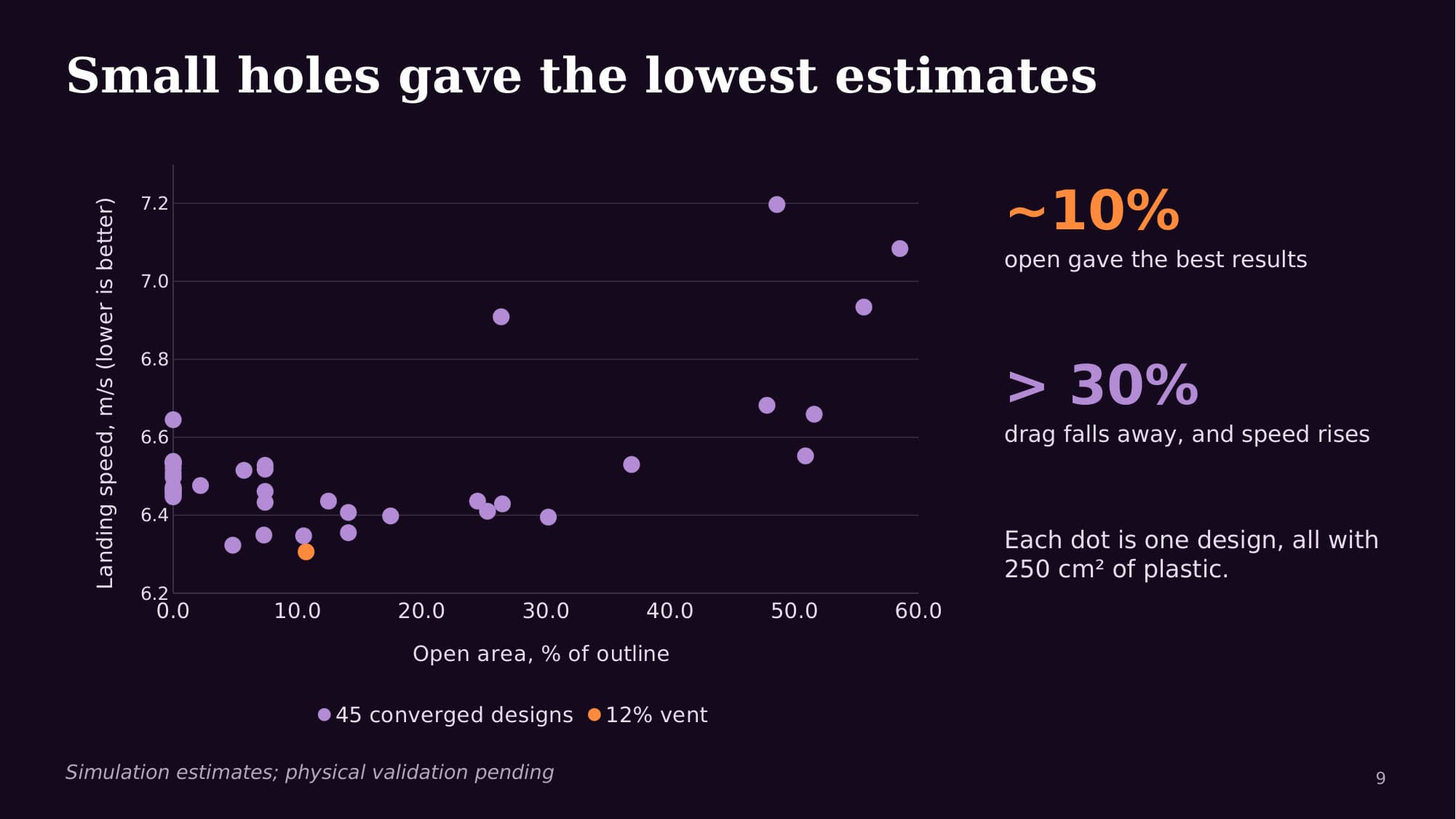
- CFD on form-found canopies with 0%, 12%, 30% and 49% open area, then 45 converged designs across open fractions.
- Result
- The 12% vent gave 6.31 m/s against 6.45 m/s plain, 0.14 m/s slower with 54% less pitch instability, though not yet self-righting. Around 10% open did best; above 30% drag falls away and speed rises.
Can a search beat the vent?negative result
- Question
- Does a data-driven search over nine shape variables find a canopy that beats the 12% vent?
- Method
- GA on the GP surrogate, 200 evaluations, with the best designs re-checked by fresh CFD.
- Result
- The GA reinvented the central hole. Its best design predicted 6.27 m/s but checked at 6.33 m/s in CFD, so the vent keeps the lowest checked estimate by 0.02 m/s, a gap with no uncertainty estimate yet.
Is three repeats enough for the real drops?negative result
- Question
- How many physical drops per design does the comparison need?
- Method
- Power estimate assuming 0.06 m/s drop-to-drop noise.
- Result
- Three repeats can detect a 0.139 m/s gap, about the same size as the vent's whole 0.14 m/s gain, so three repeats per design is not enough.
2 results did not confirm the hypothesis. They are reported here because an experiment that only ever confirms things is not an experiment.
Limitations and failure modes
- Every number is a simulation estimate. Physical validation is pending, and no design is claimed to win until real drops say so.
- The simulated canopy is rigid, so slits barely open (under 1 mm) and cannot show inflation; their effect enters only through the aerodynamic map.
- Optimising on the surrogate also finds the surrogate's mistakes: checked winners came in 0.06 to 0.17 m/s slower than predicted.
- Payload mass, line length and canopy mass are still placeholders, and the tilted-canopy CFD runs on a coarse mesh.
Gallery
Attribution
- Built by me
- All code, simulation, CFD, surrogate modelling, optimisation, firmware and analysis to date.
- My contribution within a team
- Course team project for ROB-GY 7863B at NYU Tandon with Pranav Lavande and Walter Kimball. The midway presentation was delivered by all three of us.
- Based on external research
- MuJoCo, OpenFOAM, pymoo and scikit-learn are upstream tools; dynamic relaxation (Day, 1965), k-ω SST (Menter, 1994), the VAE (Kingma & Welling, 2014) and NSGA-II (Deb et al., 2002) are upstream methods. Reference drag coefficients from Hoerner (1965).